
Internal Teardown of Double-Action and Single-Action Airbrushes: A Taiwan Manufacturer’s Perspective on Mechanism Tolerances and Selection Guidelines
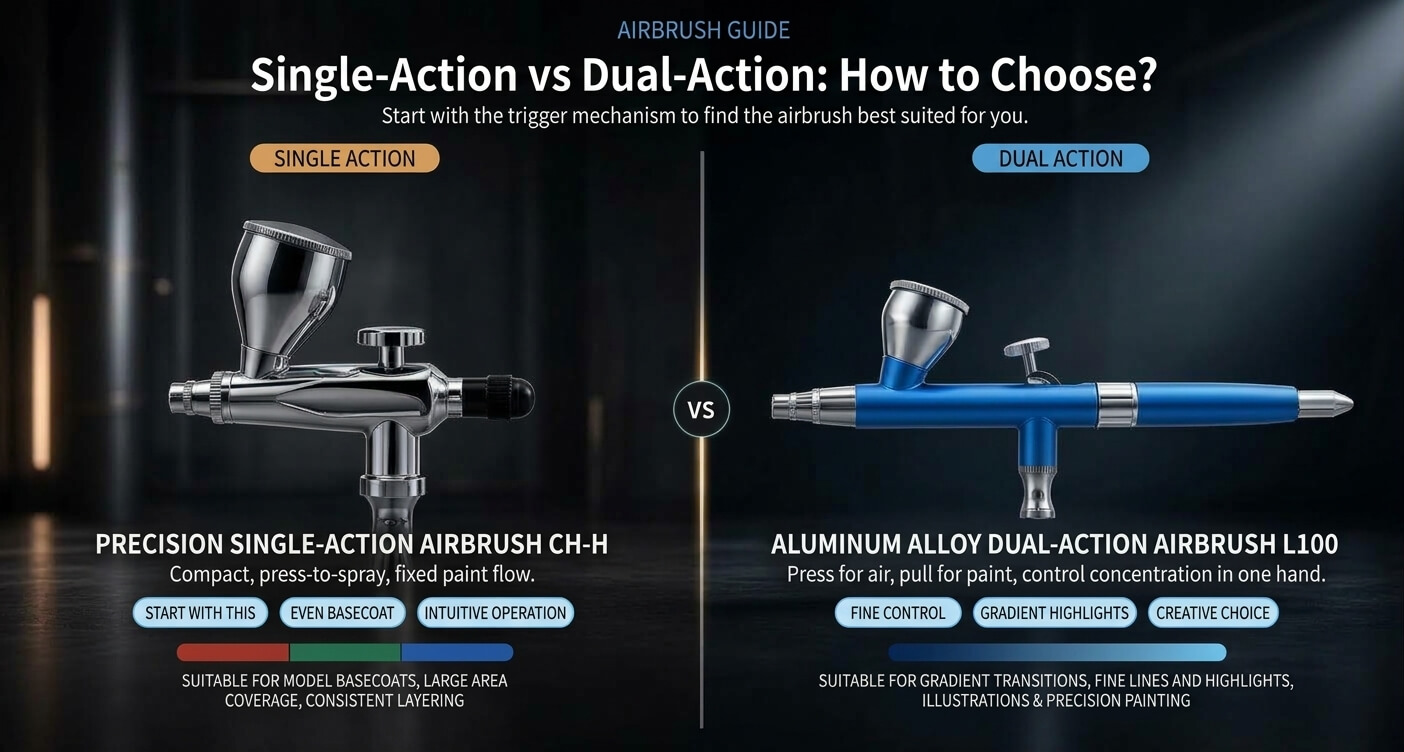
Whether it’s model painting, automotive airbrushing, nail art and makeup, or industrial prototyping, “Should I choose a single-action or double-action airbrush?” is always the first question for every creator and technician.
Many unboxing posts will tell you: “Single-action sprays paint when you press down; double-action presses for air and pulls back for paint.” But to the production-line technicians at CYC Chuan Yi Cheng, with nearly 30 years in pneumatic tools, precision airbrushes, and hardware machining, these two designs are far more than a difference in “hand motion”—they are a fundamental divide in “fluid-dynamics design” and “machining tolerance requirements.”
Today, we will completely “tear down” the airbrush and, from the internal structure, take you deep into the secrets of single-action and double-action airbrush mechanisms—from a manufacturing and hands-on maintenance perspective.
Quickly Understand the Core Differences: Operating Logic Determines the Internal Linkage Mechanism
Before dismantling the parts, first clarify the essential differences in mechanical actuation:
| Comparison Item | Single-Action Airbrush (Single-Action) | Double-Action Airbrush (Double-Action) |
| Trigger Action | Single direction only (typically press down) | Two-way free linkage (press down for air, pull back to retract the needle) |
| Paint Flow Control Method | Continuously adjustable in real time by how far the finger pulls back during operation | Pre-adjust the needle position by turning the rear stop nut |
| Number of Internal Mechanism Parts | Approx. 12–16 components (compact, straightforward structure) | Approx. 20–28 components (including rocker/lever, guide bushing, and spring clamp) |
| Sensitivity to Machining Tolerances | Moderate (focused on simple on/off of the air valve and paint path) | Extremely high (highly dependent on concentricity, linear lever feedback, and smooth sealing/sliding) |
| Primary Use Cases | Large-area even coating, primer, ceramic glaze, beginner use | Gradient edging, fine-line work (0.2–0.3 mm), shadows and highlights, detailed model finishing |
Single-Action Internal Teardown: Minimalist, Rugged, and Stable Paint Delivery
Single-action airbrushes are designed to be “durable, resistant to clogging, and extremely easy to maintain.”
Note: Only with proper maintenance and care can an airbrush maintain optimal spray quality and durability.
1. Mechanism Breakdown
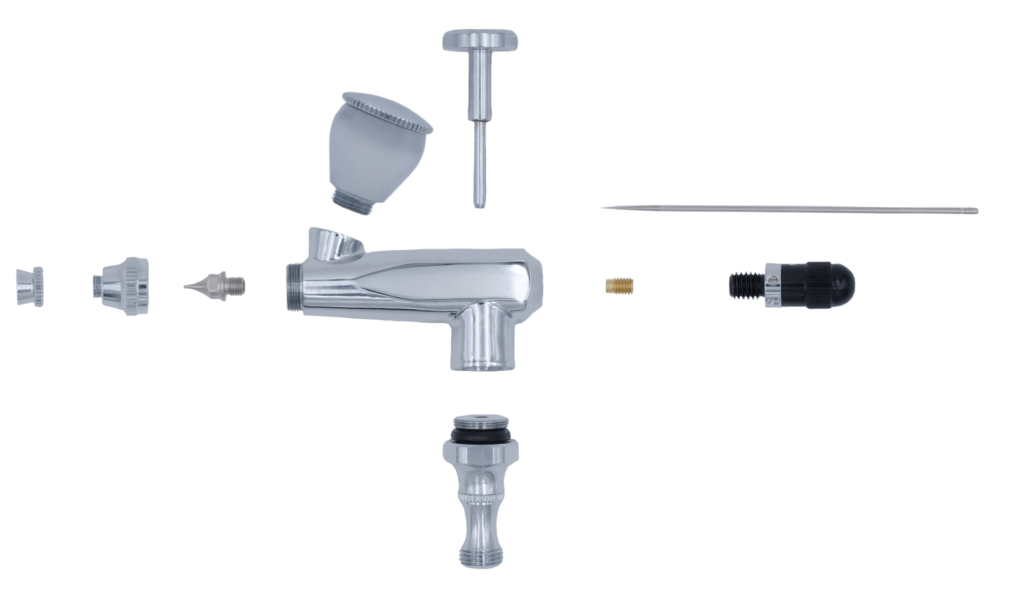
When you open up a single-action airbrush (such as an external-mix siphon-feed type or a compact single-action CH-H):
- Air Valve Assembly: When the trigger is pressed down, the valve piston simply overcomes the preload of the air-valve spring at the bottom, fully opening the path for compressed air into the air chamber.
- No lever linkage design: There is no complex tilting lever under the trigger. Before spraying, the needle position is typically set by using the rear “needle adjusting knob” to fix the needle at a specific paint opening.
- Paint path and air path: In many external-mix single-action airbrushes, paint does not even enter the main body cavity; instead, it is drawn up through the siphon tube and mixes with airflow around the outside of the nozzle (Venturi atomization).
💡 From CYC’s manufacturing perspective: Where is the technical value of single-action?
Many people mistakenly think single-action airbrushes are “low-tech”—a misconception from those unfamiliar with the field.
The strengths of single-action airbrushes lie in “high-viscosity tolerance” and “production-line durability.” In mass production, the single-action design reduces moving joints by 40%, meaning a lower chance of paint backflow leaking into the rear mechanical chamber. For environments that require continuous spraying for hours—primer, metal protective coatings, or batch craftwork—single-action airbrushes do not require constant, tense control of finger travel. With an extremely low failure rate and cleaning that takes only minutes, they are the most trusted tools on the production line.
Double-Action Internal Teardown: Precision Balance Across Multiple Components
Double-action airbrushes—most commonly used by modelers and artistic airbrush users—have a much more complex internal structure. Every smooth paint-delivery experience relies on the tight coordination of six key modules:
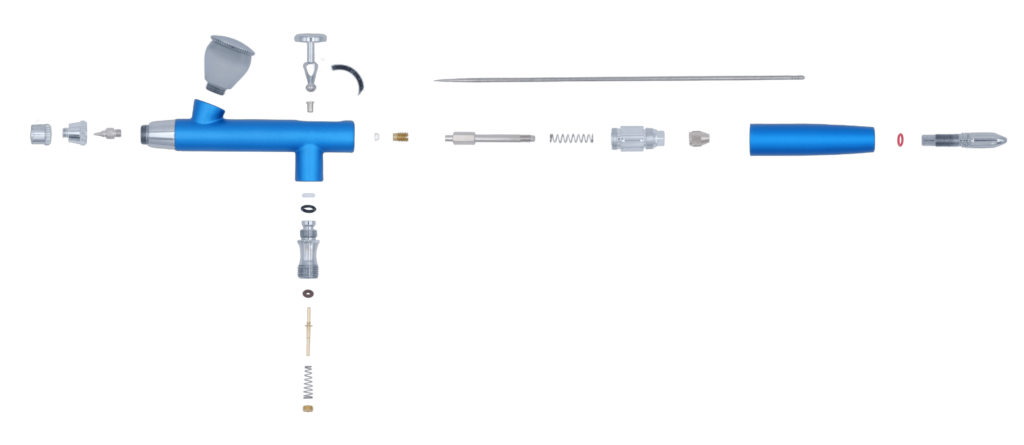
1. The Control Hub: Trigger and Needle Rocker/Lever
- Press-down motion: The vertical pin at the bottom of the trigger pushes the air valve, opening the sealed O-ring to release airflow.
- Pull-back motion: The midsection of the trigger engages a curved lever. When the finger pulls back, the trigger drives the lever to tilt backward, which moves the “needle chucking guide,” pulling the needle rearward to expose the nozzle gap and release paint.
- Manufacturing pain point: If the tolerances of the lever and trigger-slot opening are too large, users will feel “excessive initial dead travel” or “sticky rebound.” In CYC’s precision machining, the chamfering and mirror polishing here directly determine the refined feel of fingertip control.
2. The Heart: Ultra-Precision Fit Between the Needle and Nozzle
- Most airbrush needles use hardened stainless steel with a precise taper angle; nozzles are commonly turned from copper alloy or tungsten steel. CYC, however, insists on using “stainless-steel nozzles” across the entire lineup, delivering superior durability and long-term stability.
- Whether a double-action airbrush can consistently spray hairline-thin lines depends on the “concentricity” between the needle and nozzle. If concentricity is off, the annular gap becomes uneven as the needle retracts, causing asymmetric, off-center oval spray patterns, and may even lead to paint buildup and paint spatter.(Note: Every airbrush undergoes standard QC testing before shipment. If paint flow becomes inconsistent later, it is usually due to improper cleaning, maintenance, or reassembly.)
3. The Most Overlooked Gatekeeper: Needle Packing Screw
In a double-action airbrush, the paint cup is connected to the rear mechanical chamber (spring, lever). The only line of defense is the central packing.
- Older or low-cost airbrushes use ordinary rubber, which can easily swell or harden when exposed to lacquer paint, lacquer thinner, or cleaning agents—causing the needle to seize or paint to backflow into the rear chamber.
- Professional manufacturing standard: CYC Chuan Yi Cheng insists on using highly solvent-resistant PTFE (Teflon) sealing components, and precisely controls preload through precision threads—blocking paint seepage 100% while allowing the needle to slide with extremely low friction.
Production-Line Field Tests: Troubleshooting the Most Common “Internal Issues” Users Encounter
In our day-to-day handling of customer repair returns and spray testing, more than 80% of airbrush problems are not due to part damage, but are “internal issues” caused by improper disassembly/reassembly and cleaning:
Pain Point 1: Air only when pressed, but no paint when pulled back?
- Layperson’s guess: The paint is too thick or the nozzle is clogged.
- Structural truth: Remove the handle and check the “needle chucking nut.” Many users fail to tighten this nut after cleaning. When the trigger pulls back, the chucking guide retracts, but the needle itself does not move at all and remains in place.
Pain Point 2: As soon as you press the air valve, a large amount of bubbles rises in the paint cup (rolling bubbles)?
- Structural truth: This indicates that “airflow is blowing back into the paint path.” Check whether the front nozzle is not tightened, the airtight O-ring at the nozzle threads is damaged/aged, or there is caked residual paint inside the nozzle cap. When the air outlet path is obstructed, high-pressure air will naturally backflow into the paint cup through the paint path.
Pain Point 3: After releasing the trigger, rebound is slow and it cannot instantly cut off paint and air?
- Structural truth: Paint has seeped into the rear spring chamber and adhered around the needle guide spring and lever; or, during cleaning, the entire airbrush was soaked in a strong solvent, washing out the lubricant in the air valve and causing the air-valve O-ring to swell and deform.
Conclusion: Choose a Precision Airbrush Built for Real-World Use
Double-action airbrushes are made for detail and ultimate artistic expression, offering freeform gradients and lines; single-action airbrushes are the solid backbone for efficiency, stability, and large-area even coverage. There is no absolute “better” tool—only the right fit for your production and creative needs.
As a Taiwan-based partner with nearly 30 years of experience in spray-tool manufacturing and hardware machining, CYC Chuan Yi Cheng understands that behind every air-channel grind, every nozzle thread, and every needle polish lies creators’ and operators’ insistence on stable atomization. From standard push-button airbrushes and ergonomic trigger-style airbrushes to a wide range of customized pneumatic accessories, we uphold Taiwan precision manufacturing standards to deliver the most reliable spray feel for customers worldwide.
👉 Want to learn more about professional airbrush specifications, custom hardware machining, or pneumatic accessory solutions? Contact CYC Chuan Yi Cheng and speak with our team.