
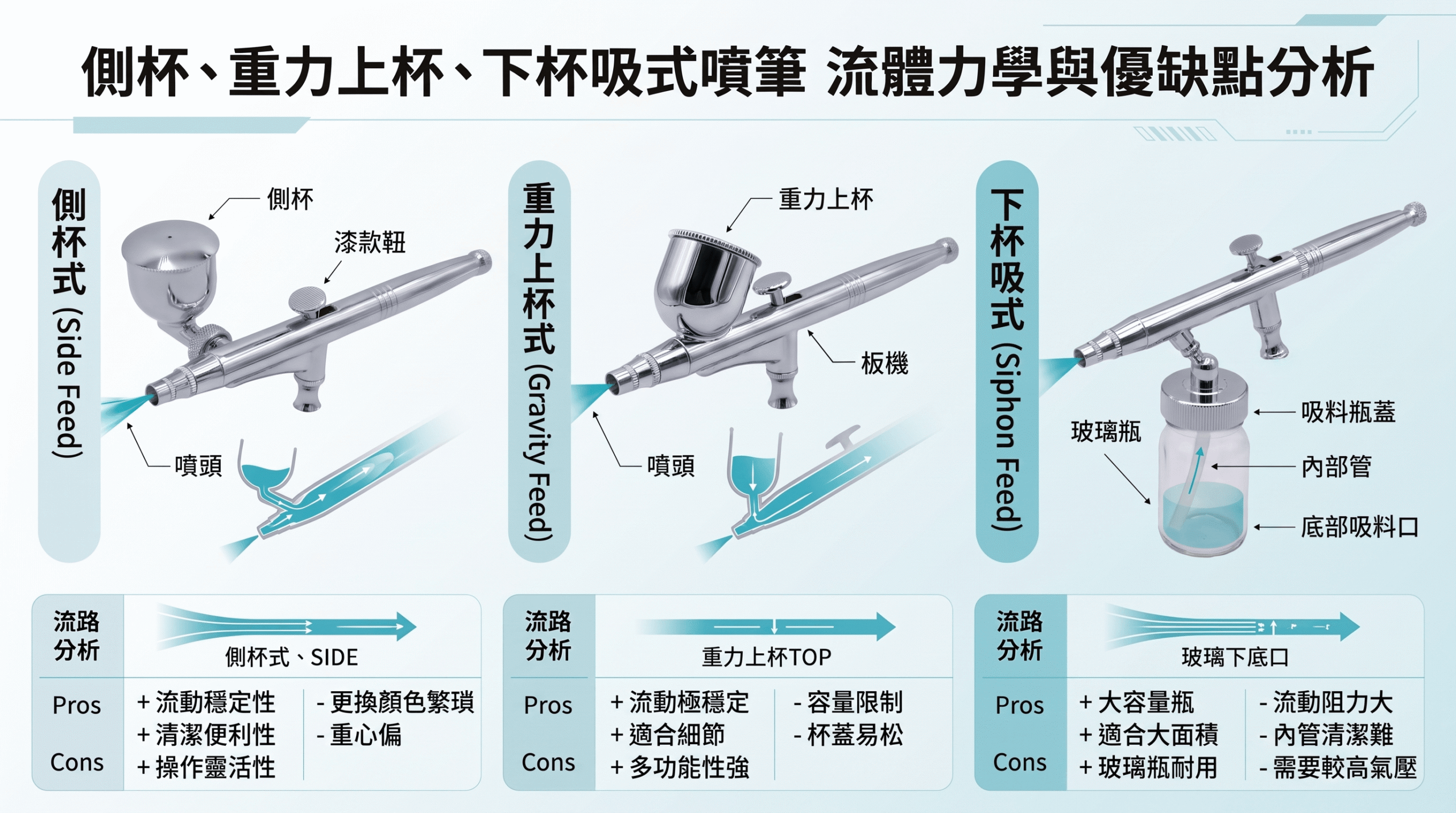
When selecting and evaluating a pneumatic airbrush (Airbrush), most users intuitively focus on “paint cup capacity” or “grip feel.” However, in mold development and precision CNC turning/milling environments, the feed system is essentially a mechanical equilibrium system of fluid transfer and Venturi-effect negative pressure.
The feed structure directly determines:
- The requiredminimum operating air pressure (Min. Operating PSI) .
- The head loss and pulse response as paint flows from the passage into the air-cap zone.
- The droplet size distribution at the needle tip.
With nearly 30 years of experience in precision spray-tool manufacturing and CNC hardware machining, CYC Co., Ltd. goes beyond a simple user unboxing perspective in this article. From the underlying logic of fluid dynamics and metalworking precision, we provide a thorough analysis of the pros, cons, and use cases of Gravity Feed, Siphon/Bottom Feed, and Side Feed.
I. Gravity Feed: The Performance Benchmark for Ultra-Fine Atomization at Low Pressure
1. Fluid-Dynamics Mechanism
In a gravity-feed airbrush, the paint cup is positioned above the body. Driven by the hydrostatic head (Hydrostatic Head) generated by vertical gravity, the paint flows directly down to the nozzle base, forming a “synergistic push–pull effect” with the Venturi-induced negative pressure at the front air cap.
2. Fluid-Dynamics Advantages
- Extremely low operating-pressure threshold: Because gravity already provides stable positive-pressure feeding, the paint can still flow smoothly even when the compressor is set to an ultra-low 8–15 PSI. This makes gravity-feed airbrushes the only irreplaceable choice for spraying “hairline” lines and ultra-fine shading.
- Short flow path, no dead zones, instant response: The bottom of the cup connects directly to the area in front of the needle seal seat, resulting in a short flow path. When the trigger pulls the needle back, paint delivery is almost instantaneous, with minimal paint cut-off or dot-like pulsing caused by air-pressure rebound.
- Minimal cleaning-solvent consumption: With the smallest internal chamber surface area, color changes require only a few drops of solvent; positive-pressure back-flushing (Back-flushing) quickly cleans the system.
3. Fluid-Dynamics Drawbacks and Process Limitations
- Obstructed top-down view: A fixed top cup can block the forward line of sight for close-up detailing, requiring slight grip adjustments or a tilted viewing angle.
- Limited at steep upward angles: When the airbrush is tilted upward beyond a certain angle, paint may spill over the cup rim. As the fluid level shifts backward, the pressure head can disappear, causing intermittent paint flow.
II. Siphon/Bottom Feed: Negative-Pressure Challenges for Mass Production and High-Volume Spraying
1. Fluid-Dynamics Mechanism
In a siphon/bottom-feed airbrush, paint is stored in a bottle beneath the body. Feeding relies entirely on high-speed negative pressure generated by airflow at the nozzle’s outer edge, which “lifts and draws” the paint upward through the pickup tube.
2. Fluid-Dynamics Advantages
- No practical capacity limit and fast color changes: Paint bottles can be expanded from 20 ml to over 60 ml, or swapped directly via quick-release connectors. This is ideal for large-area priming on models, automotive spot repair, leather dyeing, or batch spraying in factories.
- Excellent horizontal visibility: The top of the airbrush body is completely flat, providing a wide, unobstructed view of the workpiece.
3. Fluid-Dynamics Drawbacks
- High PSI requirement: The negative pressure generated by airflow must first overcome the paint’s vertical lift and the friction loss in the long tube. Typically, 20–35 PSI or higher is required to maintain stable atomization, making ultra-low-pressure close-range precision work impractical.
- Low tolerance for high viscosity: If the paint is mixed too thick (high viscosity), shear resistance in the long tube increases exponentially, easily leading to poor pickup, coarse spray particles, or even spitting and clogging.
- Delayed response and residual-paint blind spots: Large amounts of paint can adhere to the tube wall, and each change requires thorough cleaning of the bottle-cap interface and the tube interior. Cleaning time and solvent consumption are relatively higher.
III. Side Feed: Mechanical Balance for Unobstructed Visibility and Full-Angle Spraying
1. Fluid-Dynamics Mechanism
A side-feed airbrush places the cup connector on the side of the body, and most are equipped with a 360-degree rotating swivel joint (Swivel Joint). Paint flows in horizontally from the side into the needle channel.
2. Fluid-Dynamics Advantages
- Full-angle spraying with no dead zones: Whether spraying upward onto a ceiling or downward into deep grooves inside a mold, as long as the side cup is rotated to keep the liquid level horizontal, gravity and feed pressure remain balanced, with no risk of paint leakage.
- Zero top-side obstruction: The line of sight is not blocked by any cup body, which is highly advantageous for illustration touch-ups and extreme model surface detailing that demand precise positioning.
- Flexible compatibility with both characteristics: It can be paired with a small side gravity metal cup, or connected to a large-capacity side-mounted siphon bottle.
3. Fluid-Dynamics Drawbacks
- Higher minor loss at bends: Side-feed passages typically include a 90-degree bend. Local micro-vortices can form at the elbow, imposing stricter flowability requirements for high-viscosity paints.
- High maintenance cost for sealing components (O-rings): The side swivel mechanism relies on solvent-resistant PTFE or fluoroelastomer sealing rings. If the seal ages or wears, minor lateral air leakage can occur, releasing Venturi negative pressure and preventing paint delivery.
IV. Comprehensive Comparison of Fluid Characteristics and Machining Requirements Across the Three Feed Structures
| Evaluation Criteria | Gravity Feed | Siphon Feed | Side Feed |
| Feed driving principle | Hydrostatic head + Venturi negative pressure | Pure Venturi suction | Venturi negative pressure + side-mounted free-angle adjustment |
| Minimum stable operating air pressure | Low (8–15 PSI) | High (20–35 PSI) | Medium (12–20 PSI) |
| Close-range hairline control | ★★★★★ (Best choice) | ★★☆☆☆ | ★★★★☆ |
| Endurance for large-area spraying | ★★☆☆☆ | ★★★★★ (Best choice) | ★★★★☆ (Depends on cup type) |
| Flexibility for upward/downward angles | Prone to spilling; angle-limited | At larger upward angles, air is easily drawn in | ★★★★★ (360° adjustable) |
| Instant paint-response performance | Immediate, no delay | Slight delay (pickup tube must fill) | Smooth (slightly inferior to gravity feed) |
| Ease of cleaning the flow path | Easiest and fastest | Requires additional cleaning of the long tube | More corners and shaft-seal dead zones; requires careful cleaning |
V. A Manufacturer’s Key Perspective: Why Machining Precision Is the Core Determinant of Fluid Performance
Regardless of the feed structure used, the final performance of a spray tool ultimately depends on concentricity and flow-path surface finish in the manufacturing process.
On the precision metalworking and assembly lines at CYC, we implement the following key process standards to ensure airbrush fluid performance:
- Concentricity tolerances for the air cap and micro nozzle are controlled within standard limits: If the nozzle tip is eccentric, the annular gap of the high-speed airflow from the air cap becomes uneven, causing asymmetric local negative pressure. In siphon-feed airbrushes, this can lead to “intermittent spitting,” while in gravity-feed airbrushes it can cause a “spray cone偏 to one side” or coarser particles.
- All-stainless precision nozzles and needles (replacing the commonly used nickel silver found in the market): Commercial nozzles commonly use softer nickel silver, which can gradually erode and deform under particle abrasion and needle impact, enlarging the orifice. Over-tightening during disassembly can also easily strip threads or snap the part, rendering the entire airbrush unusable. CYC uses high-spec stainless-steel nozzles and needles across the board, offering better wear resistance, impact resistance, and torsional strength. This not only maintains long-term dimensional stability and reduces atomization偏 and paint leakage, but also makes disassembly and maintenance less prone to thread stripping or breakage.
- A highly chemical-resistant, airtight structure with no risk of solvent corrosion: Especially for side-cup swivel mechanisms and multifunction button/trigger structures, we fully adopt premium sealing materials and tight tolerance fits to prevent swelling or air leakage when using spray solvents (Thinner).
Conclusion: How to Choose the Right Spray Feed Structure for Your Project
- Ultimate fine detail, low-pressure shading, and model detail painting: Prioritize a gravity-feed airbrush. With the most direct fluid transfer and the most stable paint delivery, it is the top choice for high-resolution spraying.
- Batch production, priming large workpieces, and frequent color changes: Prioritize a siphon/bottom-feed airbrush. With multiple pre-filled bottles, production-line waiting time can be significantly reduced.
- Special-angle spraying (e.g., automated arm end-effectors, ceiling murals) and maximum emphasis on unobstructed visibility: A side-feed airbrush balances visibility and full-angle operation, providing the operator with the highest geometric freedom.
Precision Spray Tools and OEM/ODM Manufacturing Partner: CYC
An airbrush is not merely an art tool—it is a precision instrument that integrates fluid dynamics with precision metal cutting.
CYC Co., Ltd. focuses on the R&D of high-precision pneumatic spray tools, the manufacturing of button-type and trigger-type airbrushes, and customized CNC turning/milling parts machining. We provide globally recognized brand owners and professional industrial customers with highly competitive OEM/ODM solutions.
If you are looking for airbrush products or custom development services with stable quality, excellent atomization, and stringent machining tolerances, you are welcome to visit the official CYC website to learn more about our manufacturing expertise, or contact us directly for consultation.